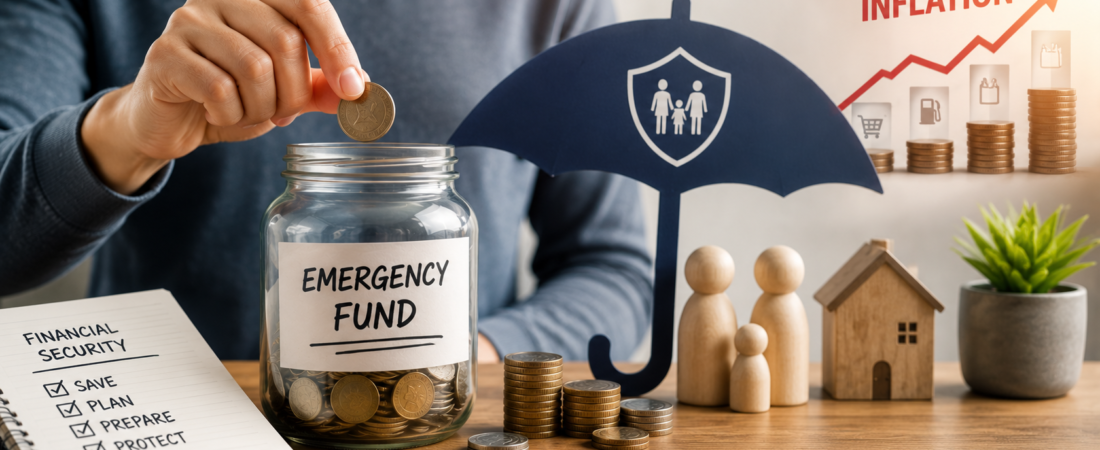
With inflation still hovering above target levels in 2026, the traditional advice of “save 3-6 months of expenses” isn’t enough. Rising prices mean your emergency fund needs to work harder, grow faster, and protect its purchasing power against ongoing cost increases.
This guide shows you exactly how to build an inflation-resistant emergency fund using proven strategies, high-yield savings accounts, and smart allocation tactics that work in today’s economic environment.
What you’ll learn:
- How much emergency savings you actually need in 2026 (with inflation-adjusted calculations)
- The best high-yield savings accounts offering 4-5% APY
- Step-by-step action plan to build your fund in 6-12 months
- Investment options that beat inflation without risking your emergency money
- Common mistakes that destroy emergency fund purchasing power
Why Traditional Emergency Fund Advice Fails During High Inflation
The Purchasing Power Problem
In 2020, $10,000 saved covered 6 months of basic expenses for many households. By 2026, that same $10,000 might only cover 4 months due to cumulative inflation. Here’s the math:
Traditional Approach:
- Target: $15,000 (5 months × $3,000/month)
- 2024 savings: Covers 5 months
- 2026 reality: Covers only 3.5-4 months due to 20-25% cumulative inflation
Inflation-Adjusted Approach:
- Target: $18,750 (5 months × $3,750/month with inflation)
- Includes 25% buffer for continued price increases
- Invested partially in inflation-beating vehicles
According to financial experts, you need to increase your emergency fund target by 15-30% in high-inflation environments to maintain the same safety net.
Interest Rates vs. Inflation: The Real Return Matters
In 2026, traditional savings accounts offering 0.01-0.1% APY are losing you money in real terms:
| Account Type | Nominal APY | Inflation Rate | Real Return |
|---|---|---|---|
| Traditional Savings | 0.01% | ~3% | -2.99% |
| High-Yield Savings | 4.5% | ~3% | +1.5% |
| Money Market Fund | 4.8% | ~3% | +1.8% |
| I-Bonds (2026 rate) | 4.97% | ~3% | +1.97% |
Key insight: Your emergency fund must earn at least 3-4% APY just to break even with inflation.
Step 1: Calculate Your Inflation-Adjusted Emergency Fund Target
The Modern Emergency Fund Formula
Use this 2026-adjusted formula instead of the outdated “3-6 months” rule:
Emergency Fund Target = (Monthly Essential Expenses × 4) + Inflation Buffer + Job Security Factor
Where:
- Monthly Essential Expenses: Rent/mortgage, utilities, groceries, insurance, minimum debt payments, transportation
- Inflation Buffer: 20-25% added to account for continued price increases
- Job Security Factor: Add 1-2 months if you’re in a volatile industry
Example Calculation for 2026
Let’s say your current monthly essentials total $3,200:
textBase Target: $3,200 × 4 = $12,800
Inflation Buffer (25%): $12,800 × 0.25 = $3,200
Job Security Factor (1 month): $3,200
________________________________________
TOTAL TARGET: $19,200
Pro tip: If you’re self-employed, freelance, or work in tech/engineering with project-based income, add 2-3 extra months ($6,400-$9,600) for a total of $25,600-$28,800.
Example : Your Personal Target
| Monthly Essential Expense | Amount |
|---|---|
| Rent/Mortgage | $_ |
| Utilities (electric, water, internet) | $_ |
| Groceries & Household Items | $_ |
| Insurance (health, auto, home) | $_ |
| Minimum Debt Payments | $_ |
| Transportation (fuel, public transit) | $_ |
| Total Monthly Essentials | $ |
| × 4 months | $_ |
| + 25% inflation buffer | $_ |
| + Job security months | $_ |
| FINAL EMERGENCY FUND TARGET | $ |
Step 2: Choose the Right Account Type for 2026
Best Emergency Fund Accounts Ranked by 2026 Returns
Our Recommendation: The 3-Tier Emergency Fund Strategy
For 2026, don’t keep all emergency money in one place. Use this tiered approach:
Tier 1: Immediate Access (30% of fund)
- Account: High-Yield Savings Account
- APY: 4.5%
- Purpose: Emergencies needing same-day access
- Amount: 1-2 months of expenses
Tier 2: Short-Term Access (50% of fund)
- Account: High-Yield Savings or Money Market Fund
- APY: 4.5-5.0%
- Purpose: Emergencies within 1-3 days
- Amount: 2-3 months of expenses
Tier 3: Inflation Protection (20% of fund)
- Account: I-Bonds or 6-month CD ladder
- APY: 4.97% (I-Bonds) or 4.5% (CDs)
- Purpose: Emergency fund excess, inflation hedge
- Amount: 1 month of expenses (access after 12 months for I-Bonds)
Why this works: You maintain full liquidity while earning 4.5-5% on the entire fund, beating inflation by 1.5-2% annually.
Top High-Yield Savings Accounts in 2026
Based on current rates and features:
- Ally Bank High-Yield Savings – 4.60% APY, no minimum, excellent mobile app
- Marcus by Goldman Sachs – 4.55% APY, no fees, easy transfers
- Discover Bank – 4.50% APY, cashback bonuses, FDIC insured
- Capital One 360 – 4.50% APY, no minimum, integrated banking
- American Express National Bank – 4.65% APY, highest rate, reliable service
Action item: Open a HYSE today with at least one of these banks. Most allow online setup in 10 minutes with $0-100 minimum.
Step 3: Build Your Fund in 6-12 Months (Action Plan)
The 6-Month Sprint Strategy
If your target is $19,200 and you start from zero:
| Month | Monthly Savings | Cumulative Total | Milestone |
|---|---|---|---|
| 1 | $1,600 | $1,600 | First $1K achieved |
| 2 | $1,600 | $3,200 | 1 month essentials |
| 3 | $1,600 | $4,800 | Emergency starter complete |
| 4 | $1,600 | $6,400 | 🔥 Halfway to 2 months |
| 5 | $1,600 | $8,000 | |
| 6 | $1,600 | $9,600 | ✅ 2 months complete |
| 7 | $1,600 | $11,200 | |
| 8 | $1,600 | $12,800 | 🔥 Halfway to 3 months |
| 9 | $1,600 | $14,400 | |
| 10 | $1,600 | $16,000 | |
| 11 | $1,600 | $17,600 | |
| 12 | $1,600 | $19,200 | ✅ GOAL ACHIEVED |
Can’t save $1,600/month? Start with what you can afford. Even $500/month gets you to $6,000 in a year (1.5 months essentials).
10 Proven Ways to Accelerate Your Emergency Fund
- Automate transfers – Set up automatic $_ transfer on payday (pay yourself first)
- 50/30/20 rule adjustment – Redirect 5% from “wants” to emergency fund temporarily
- Side hustle income – Freelance engineering, tutoring, or consulting (100% to emergency fund)
- Tax refund – Deposit entire refund (or 75%) into emergency fund
- Work bonuses – Commit 50-100% of bonuses to emergency savings
- Sell unused items – Electronics, clothes, furniture (target: $500-1,000)
- Negotiate bills – Call providers to lower internet, insurance, phone (save $100-200/month)
- Meal prep instead of dining out – Save $200-400/month
- Pause retirement contributions – Temporarily reduce 401(k) to 0% match (only if debt-free)
- Windfall rule – 50% of any unexpected income goes to emergency fund
The “No-Spend Challenge” Method
Try a 30-day no-spend challenge on non-essentials:
- No dining out
- No entertainment subscriptions (pause Netflix, Spotify temporarily)
- No shopping for clothes, gadgets, home decor
- No impulse purchases
Average savings: $400-800/month = $4,800-9,600/year toward your emergency fund.
Step 4: Protect Your Emergency Fund from Inflation
What NOT to Do With Your Emergency Fund
❌ Don’t invest in stocks – Market volatility defeats the purpose of emergency money
❌ Don’t put in crypto – Too risky; 50% drops are common
❌ Don’t use for home down payment – That’s a separate savings goal
❌ Don’t keep in checking account – Earning 0% while inflation erodes value
❌ Don’t lend to family/friends – Emergency fund must be fully accessible to YOU
Smart Inflation-Hedging Strategies
Strategy 1: I-Bonds for Backup Emergency Fund
- Series I Bonds earn 4.97% (2026 rate) with inflation protection
- Purchase limit: $10,000/year per person
- Penalty: Lose 3 months interest if redeemed before 5 years
- Best for: Excess emergency fund beyond 3 months essentials
Strategy 2: Short-Term Treasury Bills
- 3-month T-Bills: 4.8% APY, state tax-exempt
- 6-month T-Bills: 4.9% APY, state tax-exempt
- Best for: Tier 2 emergency fund (1-3 day access via brokerage)
Strategy 3: CD Ladder for Stability
6-month CD: $3,000 @ 4.5%
9-month CD: $3,000 @ 4.6%
12-month CD: $3,000 @ 4.7%
When each matures, roll into new 12-month CD. Provides 4.5-4.7% returns with predictable access.
Step 5: Maintain and Grow Your Emergency Fund
When to Reassess Your Target
Recalculate your emergency fund target when:
- ✅ Your monthly expenses increase by 10%+ (due to inflation or lifestyle changes)
- ✅ You change jobs or industries
- ✅ You get married, divorced, or have children
- ✅ You buy a house or take on significant debt
- ✅ Every 6 months (schedule this in your calendar)
The Inflation Adjustment Rule
Increase your emergency fund target by 3-5% annually to keep pace with inflation:
2026 Target: $19,200
2027 Target (4% inflation): $19,200 × 1.04 = $19,968
2028 Target (4% inflation): $19,968 × 1.04 = $20,767
Action: Set a calendar reminder for June 1st each year to recalculate.
What to Do When You Use Emergency Fund Money
The Rebuilding Protocol:
- Immediately pause discretionary spending for 30 days
- Redirect 50% of income to emergency fund until restored
- Resume normal savings only after reaching 75% of target
- Add 10% buffer on top of original target to prevent future shortfalls
Example: If you used $5,000 for car repairs:
- Month 1-3: Save $1,667/month to fully replenish
- Months 4-6: Save $1,000/month to build 10% buffer ($5,500 total)
- New target: $24,700 (was $19,200 + $5,500)
Common Emergency Fund Mistakes (And How to Avoid Them)
Mistake #1: Waiting Until You Have “Enough”
Problem: People wait until they can save $10K before starting
Solution: Start with $500 or $1,000. Any emergency fund is better than none
Mistake #2: Keeping All Money in One Account
Problem: Single account limits interest earnings or access speed
Solution: Use the 3-tier strategy (Tier 1: 30%, Tier 2: 50%, Tier 3: 20%)
Mistake #3: Using Emergency Fund for “Maybe” Emergencies
Problem: Spending on vacations, upgrades, or non-urgent repairs
Solution: Define emergency clearly: “Only for unexpected, necessary expenses threatening financial stability”
Mistake #4: Not Automating Savings
Problem: Relying on willpower to save at month-end
Solution: Automate transfers on payday. If it’s automatic, you won’t spend it
Mistake #5: Ignoring Inflation Completely
Problem: Saving $15K in 2024 and assuming it’s still enough in 2026
Solution: Increase target by 3-5% annually and earn 4%+ APY
Real-Life Case Study: Engineering Professional Builds $28K in 10 Months
Profile: Sarah Mitchell, Automotive Embedded Software Engineer, Austin, Texas
Starting Point: $3,500 savings, $4,200/month expenses (higher cost of living in Austin)
2026 Target: $25,200 (4 months × $4,200 × 1.25 inflation buffer)
Her Strategy:
- Opened Marcus by Goldman Sachs HYSA at 4.55% APY
- Automated $3,000/month transfer (60% of take-home pay after Texas state tax savings)
- Freelance AUTOSAR consulting: $1,200/month extra → 100% to emergency fund
- No-spend challenge (30 days): Saved $850 (cut dining out and entertainment in Austin)
- Sold old laptops and car parts: $620
- Year-end bonus: $3,500 (75% = $2,625 to emergency fund)
Results After 10 Months:
- Total saved: $28,000
- Interest earned: $1,147 (4.55% APY)
- Time to goal: 10 months (2 months ahead of schedule)
- Current inflation-adjusted return: +1.55% real return after 3% inflation
Why Texas helped: No state income tax meant Sarah could redirect an extra $400-600/month compared to if she lived in California or New York, accelerating her emergency fund timeline significantly.
FAQ: Emergency Funds During High Inflation
Q: How much should I have in my emergency fund in 2026?
A: 4-6 months of essential expenses, plus 20-25% inflation buffer. For most Americans, this is $15,000-$25,000. Calculate your exact number using the formula in Step 1.
Q: Can I invest my emergency fund in stocks?
A: No. Stocks are too volatile for emergency money. Use high-yield savings (4.5% APY), money market funds (4.8% APY), or I-Bonds (4.97% APY) instead.
Q: What if I have debt and emergency fund savings?
A: Priority order:
- Save $1,000 emergency starter (迷你基金)
- Pay off high-interest debt (>7% APR)
- Build full emergency fund to 4-6 months
- Resume aggressive debt payoff or investing
Q: Is a 4.5% APY high-yield savings account worth it?
A: Yes. At 4.5% APY, your $20,000 earns $900/year vs. $2/year in traditional savings. That’s $898 extra protection against inflation.
Q: Should I use my emergency fund to pay off my mortgage early?
A: No. Paying off mortgage is a wealth-building strategy, not an emergency. Keep 4-6 months expenses liquid in emergency fund.
Q: How do I find $500-$1,000 to start my emergency fund?
A: Sell unused items ($300-600), pick up 1-2 freelance gigs ($200-400), pause subscriptions ($50-100), cook at home for 2 weeks ($100-200) = $650-1,300.
Q: What’s the difference between emergency fund and savings?
A: Emergency fund is for unexpected, necessary expenses (job loss, medical emergency, car breakdown). Regular savings is for planned goals (vacation, house down payment, new car).
Action Checklist: Start Today
✅ Today (Day 1):
- Calculate your inflation-adjusted emergency fund target using Step 1 formula
- Open a high-yield savings account (Ally, Marcus, or Discover)
- Set up automatic transfer for $_ on next payday
✅ This Week:
- Transfer initial $500-$1,000 to starter emergency fund
- List 5 items to sell on eBay/Facebook Marketplace
- Call 3 service providers to negotiate lower bills
- Cancel 2 unused subscriptions
✅ This Month:
- Complete 30-day no-spend challenge on non-essentials
- Save 100% of any windfalls (bonus, tax refund, gift money)
- Set calendar reminder for 6-month reassessment
- Create budget tracking spreadsheet (Excel like your FMEA documentation)
✅ Ongoing:
- Review emergency fund balance monthly
- Recalculate target every 6 months (June 1 & December 1)
- Replenish within 90 days if used
- Increase contributions when income increases
Conclusion: Your Emergency Fund Is Your Financial安全气囊 (Airbag)
Just like ISO 26262 functional safety requires backup systems to protect vehicle occupants, your financial life needs an emergency fund as a safety mechanism against economic shocks. In 2026’s high-inflation environment, that safety net must:
- Be larger (add 20-25% inflation buffer)
- Earn more (4.5%+ APY, not 0.01%)
- Stay liquid (accessible within 1-3 days)
- Grow automatically (scheduled recalculations)
Your next step: Open that high-yield savings account today. In 10 minutes, you can start earning 4.5% instead of 0.01%, protecting your money from inflation while building your safety net.
Remember: The best time to build an emergency fund was 5 years ago. The second-best time is right now