Introduction: The Inflation Clock Is Still Ticking
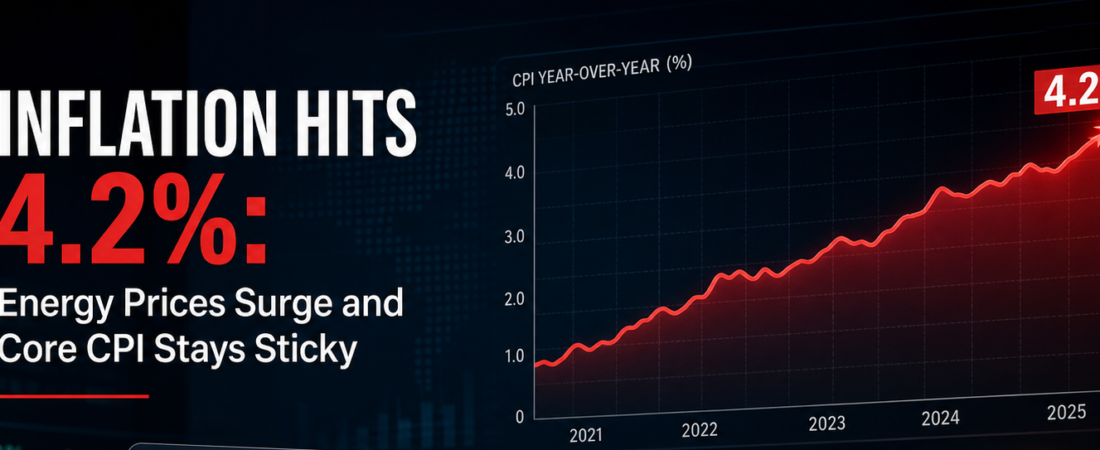
The latest U.S. Consumer Price Index (CPI) report confirms a worrying reality: inflation is not cooling as hoped. The headline inflation rate hit 4.2% year-over-year in May 2026, the highest since April 2023, while energy prices surged 23.5% annually and core inflation remained sticky at 2.9%.
This isn’t just economic noise. For households, this means your grocery bill, fuel costs, and rent are rising faster than your paycheck. For investors, it signals the Federal Reserve will likely hold interest rates higher for longer. And for anyone building an emergency fund, it means traditional savings accounts are losing you money in real terms.
Here’s what these three critical inflation numbers mean for your wallet—and how to protect yourself.
The 3 Big Inflation Numbers That Changed Everything
🔴 1. Headline CPI: 4.2% (Up from 3.8% in April)
The headline Consumer Price Index measures the total inflation rate for all consumer goods and services. In May 2026, it rose 4.2% year-over-year, surpassing April’s 3.8% and marking the first time since April 2023 that inflation exceeded 4%.
What this means: Your overall cost of living is rising faster than wages in most sectors. The Federal Reserve’s 2% target is still 2.2 percentage points away.
🔴 2. Energy Prices: +23.5% Year-Over-Year (3.9% in May Alone)
Energy inflation exploded 3.9% month-over-month in May—the largest monthly jump since late 2022. On an annual basis, energy prices are up 23.5%, driven by:
- Gasoline: +6.2% monthly, +45% annually
- Electricity: +1.8% monthly, +12% annually
- Natural gas: +2.4% monthly, +18% annually
What this means: Transportation costs, utilities, and fuel-dependent goods are exploding. If you drive, your gas bill is likely double what it was 2 years ago.
🟡 3. Core CPI: 2.9% (Up from 2.74%)
Core CPI excludes food and energy to measure “sticky” inflation from housing, medical care, and services. It rose 0.2% in May and 2.9% annually, showing that even non-energy prices remain elevated.
What this means: The Fed’s biggest concern isn’t just energy—it’s persistent inflation in housing, healthcare, and wages that won’t disappear quickly.
Why Energy Prices Are Driving Inflation Higher
The Middle East Conflict Factor
Energy prices surged due to ongoing supply disruptions from the Middle East conflict, which has tightened global oil markets. Reports from the New York Times and EY note that “Inflation breaches 4% on conflict in the Middle East,” confirming geopolitical tensions as a primary driver.
The Supply Chain Warning
When energy prices rise, they ripple through the entire economy:
- Trucking costs increase → higher shipping fees for all goods
- Plastic production costs rise → expensive packaging and products
- Manufacturing energy costs jump → pricier appliances and electronics
- Agricultural fuel costs climb → higher food prices
Bottom line: Energy inflation of 23.5% is a backward-looking signal that headline inflation could stay elevated for 6–12 more months.
What “Sticky Core CPI” Actually Means for You
Core Inflation Breaking Down
While energy drives the headline, core inflation is the Fed’s real worry. Here’s what’s dragging core CPI to 2.9%:
| Category | Monthly Change | Annual Change |
|---|---|---|
| Shelter costs | +0.3% | +3.4% |
| Rent of primary residence | +0.3% | +3.8% |
| Medical care | +0.4% | +4.2% |
| Airline fares | +2.7% | +18.5% |
| Motor vehicle insurance | -1.7% | -8.3% |
Key insight: Shelter (housing) and medical care are the biggest contributors to sticky core inflation. Rent is still rising 3.8% annually, and healthcare costs are up 4.2%.
What’s Actually Cooling
Not all categories are bad. Some are improving:
- New vehicles: -0.3% monthly (first decline in 14 months)
- Core goods: -0.1% monthly (first monthly drop since March 2022)
- Used cars & trucks: +0.1% (nearly flat)
Takeaway: The economy is mixed—energy and shelter are hot, but consumer goods are cooling.
How 4.2% Inflation Hurts Your Emergency Fund
The Purchasing Power Math
If you have $20,000 in a traditional savings account earning 0.01% APY, 4.2% inflation destroys your purchasing power:
textNominal Value After 1 Year: $20,002 (0.01% interest)
Real Value After 1 Year: $20,002 ÷ 1.042 = $19,197
Real Loss: $803 (4.0% of value)
You’re losing $803/year just by keeping money in a low-yield account.
The New Emergency Fund APY Target
With 4.2% inflation, your emergency fund needs to earn 4.5%+ APY to break even:
| Account Type | APY | Inflation Rate | Real Return |
|---|---|---|---|
| Traditional Savings | 0.01% | 4.2% | -4.19% |
| High-Yield Savings (4.5%) | 4.5% | 4.2% | +0.3% |
| Money Market Fund (4.8%) | 4.8% | 4.2% | +0.6% |
| I-Bonds (4.97%) | 4.97% | 4.2% | +0.77% |
Action: Open a high-yield savings account (Ally 4.6%, Marcus 4.55%, Discover 4.5%) today to protect your emergency fund.
Updated Emergency Fund Target for 4.2% Inflation
The old “3–6 months” rule is outdated. Use this 2026 formula:
Emergency Fund Target = (Monthly Essential Expenses × 4) × 1.25 Inflation Buffer
Example for $4,000/month expenses:
textBase Target: $4,000 × 4 = $16,000
Inflation Buffer (25%): $16,000 × 0.25 = $4,000
FINAL TARGET: $20,000
If you previously targeted $15,000, you now need $18,750 to maintain the same safety net.
What the Fed Will Likely Do Next
Interest Rate Expectations
The Fed’s preferred inflation gauge is PCE (Personal Consumption Expenditures), not CPI. The May PCE report is coming later this week, and investors are watching it closely because it will determine the Fed’s next move.
Current consensus: The Fed will hold rates steady at 5.25–5.5% because:
- 4.2% inflation is still doubled the 2% target
- Core CPI of 2.9% shows sticky inflation in housing and services
- Energy at 23.5% could keep headline inflation elevated
Rate cut timeline: If inflation stays above 4% through summer, the Fed may delay rate cuts until late 2026 or early 2027.
What to Watch Next Week
- May PCE report (June 26, 2026): Fed’s preferred inflation gauge
- Fed Chair Powell speech (July 8, 2026): Clues on rate policy
- June CPI report (July 14, 2026): Next official inflation check
FAQ: 4.2% Inflation & Your Money
Q: Is 4.2% inflation considered “high”?
A: Yes. The Federal Reserve targets 2% inflation. At 4.2%, inflation is 2.1x the target rate, classifying it as “moderate to high” inflation. This is the highest since April 2023.
Q: Should I keep more cash in my emergency fund now?
A: Yes. With 4.2% inflation eroding purchasing power, keep 4–6 months of expenses plus a 25% inflation buffer. If you previously targeted $15,000, now target $18,750.
Q: Are traditional savings accounts still safe?
A: They’re FDIC-insured and safe from loss, but losing 4.19% in real value annually at 0.01% APY. Switch to high-yield savings earning 4.5%+ to maintain purchasing power.
Q: Should I invest in stocks instead of keeping emergency cash?
A: No. Emergency funds must be liquid and stable. Stocks can drop 20–50% in crashes, defeating the purpose of emergency money. Use HYSA, money market funds, or I-Bonds.
Q: How does 4.2% inflation affect my 401(k) or retirement savings?
A: Long-term retirement accounts (5+ years) should remain invested in stocks/bonds. Historical S&P 500 returns of 7–10% annually outpace 4.2% inflation. Don’t panic-sell.
Q: Will the Federal Reserve raise interest rates to combat 4.2% inflation?
A: The Fed may hold rates steady if core inflation (2.9%) continues moderating. Watch the May PCE report later this week for signals.
Q: Is buying a house still smart with 4.2% inflation?
A: Depends on mortgage rates. If you can lock in a 30-year fixed rate below 6%, housing acts as an inflation hedge (your payment stays fixed while prices rise). If rates are 7%+, consider waiting.
Q: How do I protect my emergency fund from 4.2% inflation?
A: Use the 3-tier strategy:
- Tier 1: HYSA at 4.5% APY (+0.3% real return)
- Tier 2: Money Market at 4.8% APY (+0.6% real return)
- Tier 3: I-Bonds at 4.97% (+0.77% real return)
Earn 4.5–5% across the fund to beat inflation.
Bottom Line: 4.2% Inflation Requires Action, Not Panic
The May 2026 CPI report shows inflation at 4.2%—higher than expected, but not catastrophic. Here’s what you need to do:
- Raise your emergency fund target by 25% (from $15K to $18,750 for most households)
- Switch to high-yield savings earning 4.5%+ APY to maintain purchasing power
- Use I-Bonds for excess emergency savings — they’re inflation-protected at 4.97%
- Recalculate your target every 6 months as inflation evolves
- Don’t panic-sell investments — long-term portfolios outpace 4.2% inflation
The good news: Core goods prices fell -0.1% in May—the first monthly decline in 14 months. This suggests some inflation is moderating outside of energy.