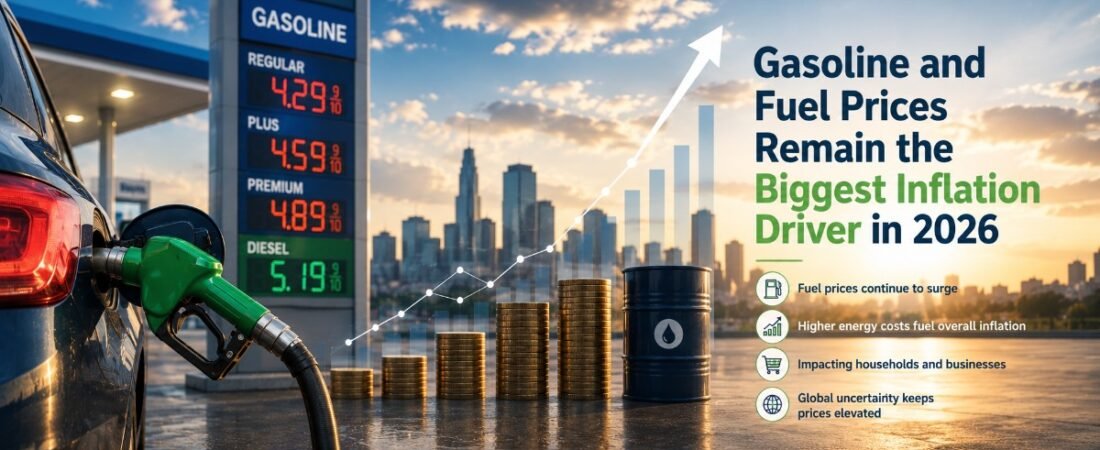
Gasoline and fuel prices are still one of the main reasons inflation remains stubborn in 2026. Even when some parts of the economy cool down, energy costs can keep pushing the cost of living higher because transportation, production, and distribution all depend on fuel.
This makes inflation feel especially persistent for households and businesses. When gasoline rises, the impact spreads quickly across groceries, deliveries, commuting, shipping, and many everyday services.
Introduction
Inflation in 2026 is not being driven by only one factor, but fuel prices have remained among the most visible and influential. Consumers often notice gasoline first because it changes quickly and is easy to compare from week to week. But the real effect of fuel inflation goes beyond the pump.
Higher gasoline prices ripple through the economy in a chain reaction. Trucking costs rise, food delivery becomes more expensive, manufacturers pay more to move goods, and retailers often pass those costs on to shoppers. This is why energy inflation can remain powerful even when other price pressures are more moderate.
For many readers, the key question is simple: why are gasoline and fuel prices still such a major inflation driver in 2026? The answer lies in supply constraints, geopolitical risks, refinery capacity, seasonal demand, and the way energy touches nearly every part of the economy.
Why fuel matters so much
Fuel is different from many other consumer goods because it affects both direct and indirect inflation. Directly, people pay more at the gas station. Indirectly, nearly every good that moves by truck, ship, or plane becomes more expensive to deliver.
That means fuel inflation can influence food prices, retail prices, construction costs, and travel expenses. A jump in gasoline also changes consumer behavior because households have less disposable income for other purchases. In economic terms, fuel inflation is not just a sector story; it is a transmission mechanism for broader inflation.
Another reason fuel matters is its psychological impact. Even if overall inflation is slowing, people see gasoline prices every day. That visibility can make inflation feel worse than official data suggests, especially when wage growth does not fully offset rising costs.
What is driving fuel prices in 2026
Several forces are keeping gasoline and fuel prices elevated in 2026. The first is global supply uncertainty. Oil markets remain sensitive to geopolitical tensions, production decisions by major exporters, and disruptions in shipping routes.
The second force is refinery bottlenecks. Even when crude oil prices are stable, a shortage of refining capacity can push gasoline prices higher. Refineries have limited flexibility, and seasonal maintenance or unexpected outages can tighten supply quickly.
The third force is seasonal demand. Summer driving season usually increases fuel consumption, especially in countries with heavy travel, tourism, and freight activity. When demand rises at the same time supply is constrained, prices often move up faster.
The fourth force is transportation dependence. Modern supply chains still rely heavily on diesel and gasoline. Even where electric vehicles are growing, most goods in 2026 are still moved by combustion-based transport systems. That keeps fuel demand structurally important.
Why inflation stays sticky
Inflation becomes sticky when one or more large components keep rising even as others stabilize. Fuel is one of the classic sticky components because it feeds into so many other prices. If gasoline remains expensive, businesses often hesitate to lower prices elsewhere.
This creates a lag effect. Official inflation measures may improve slowly, but consumers continue to feel pressure in real life. Groceries, airline tickets, package delivery, and even basic service costs can remain elevated because businesses are still paying more for energy.
Sticky inflation also makes central banks more cautious. If energy prices remain volatile, policymakers may hesitate to cut interest rates aggressively. They usually want to see clear evidence that inflation is cooling across the board, not just in a few temporary categories.
Impact on households
For households, fuel inflation hits in several ways at once. The most obvious is the direct cost of driving to work, school, and errands. Families with longer commutes or multiple vehicles feel this pressure more strongly.
But the indirect impact can be just as painful. Food prices may stay higher because of shipping and production costs. Delivery services can become more expensive. Travel budgets stretch less. Even appliances, clothing, and electronics may carry hidden transport-related costs.
Lower-income households are usually hit hardest because fuel and transportation take up a larger share of their budgets. When gasoline rises, they have less room to absorb the increase without cutting back on essentials. That makes fuel inflation not only an economic issue, but also a social one.
Impact on businesses
Businesses face fuel inflation through logistics, manufacturing, and customer service. A company that ships goods nationwide may see a sharp jump in delivery costs. A restaurant may pay more for food transport. A construction firm may spend more on machinery fuel and supply delivery.
Some businesses can pass these costs to customers, but not all can do so immediately. Competitive sectors often delay price increases to avoid losing sales. That can squeeze profit margins and reduce hiring, expansion, or investment.
Small businesses are often the most vulnerable. They usually have less bargaining power, fewer hedging tools, and thinner margins than larger firms. For them, fuel inflation can be a major operational risk, especially if it lasts for several months.
What the data usually shows
Inflation reports often separate headline inflation from core inflation. Headline inflation includes energy and food, while core inflation excludes them. Fuel prices can therefore cause headline inflation to rise even if the rest of the economy is more stable.
This distinction matters because energy can move sharply for reasons unrelated to domestic demand. A spike in oil prices may lift headline inflation quickly, but core inflation may remain relatively unchanged. Policymakers, investors, and analysts watch both measures closely.
When energy is responsible for a large share of monthly inflation gains, it signals that inflation is being pushed by supply-side pressure rather than overheating demand. That is an important difference because it changes the policy response. Interest rates can slow demand, but they cannot directly fix refinery shortages or oil supply shocks.
Why this matters for the Federal Reserve
Central banks care deeply about fuel-driven inflation because it can influence expectations. If consumers and businesses believe inflation will stay high, they may act in ways that reinforce it. Workers may ask for higher wages, firms may raise prices faster, and long-term contracts may become more expensive.
That is why even temporary fuel spikes can matter. The Federal Reserve may not react to every move in gasoline prices, but persistent energy inflation can make it harder to justify rate cuts. It can also delay confidence that inflation is truly returning to target.
In 2026, this makes the inflation debate more complicated. If fuel is the main driver, then tighter monetary policy may not solve the root cause. But if the Fed ignores it too much, inflation expectations could become less anchored. That balance is one of the hardest parts of monetary policy.
Will energy inflation continue
Whether fuel inflation continues depends on several variables. If global oil supply stays stable and refinery capacity improves, gasoline prices could ease later in 2026. If geopolitical risks rise or demand remains strong, prices may stay elevated.
Weather also matters. Severe storms can disrupt production, transport, and refining. Seasonal demand can also swing sharply depending on travel patterns. Even small shocks can create outsized effects when energy inventories are tight.
Another important factor is the transition to cleaner energy and electric vehicles. Over the long term, reduced dependence on gasoline could weaken its influence on inflation. But in 2026, that transition is still incomplete, so fuel remains a major pricing force.
What consumers can do
Consumers cannot control global oil markets, but they can reduce the impact of fuel inflation on their budgets. One useful step is to track fuel spending monthly rather than guessing. That makes it easier to see how much gasoline is affecting total household expenses.
Carpooling, better trip planning, and fuel-efficient driving habits can also help. For households with flexible schedules, shopping at times and locations with lower fuel demand can reduce commuting costs. People who work remotely part-time may save even more.
It also helps to watch related categories like food, transport, and travel. These often rise together when fuel prices are high. Understanding the connection can make budgeting more realistic and less reactive.
Conclusion
Gasoline and fuel prices remain one of the biggest inflation drivers in 2026 because energy affects almost every part of the economy. It raises costs directly at the pump and indirectly through shipping, food, travel, and business operations.
Even when some inflation categories cool, fuel can keep headline inflation elevated and keep consumers feeling pressure. That is why energy remains one of the most important inflation stories to watch in 2026, both for households and for policymakers.