Published: June 22, 2026 | Reading Time: 12 minutes
Introduction: The Numbers Your Brain Can’t Compute
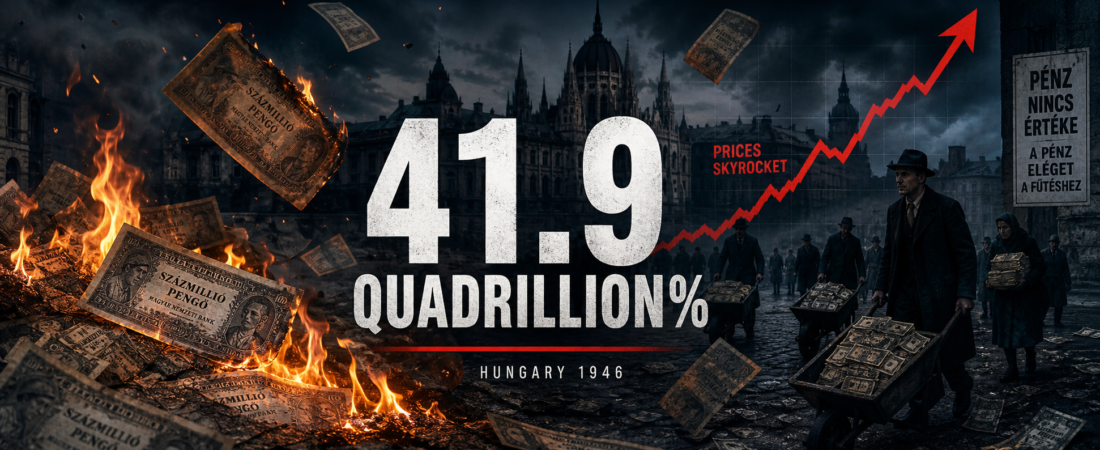
In July 1946, Hungary experienced 41.9 quadrillion percent monthly inflation — the most extreme economic collapse in human history. This is a number your brain literally cannot process: 4.19 × 10¹⁶%.
But here’s what makes it real: prices doubled every 15 hours.
By lunch, your morning groceries cost double. By bedtime, you needed triple. Workers demanded payment hourly, not daily, because a day’s wages couldn’t afford lunch. People burned cash for heat because it was cheaper than coal. A loaf of bread cost 2 million pengő in the morning, 4 million by evening.
This is not a hypothetical story. This is the most extreme inflation ever recorded, and it happened to real people who lived through it.
Today, with 4.2% inflation in 2026, you might think “this won’t happen to me.” But Hungary’s lesson is simple: small inflation differences compound catastrophically over time.
The 3 Shocking Facts About Hungary 1946
Fact 1: 41.9 Quadrillion Percent Monthly Inflation
The inflation rate was 41.9 quadrillion percent per month (4.19 × 10¹⁶% monthly). This is the highest inflation rate ever recorded in human history.
What quadrillion means:
- 1,000 = thousand
- 1,000,000 = million
- 1,000,000,000 = billion
- 1,000,000,000,000 = trillion
- 1,000,000,000,000,000 = quadrillion
41.9 quadrillion percent = 41,900,000,000,000,000% monthly inflation
Fact 2: Prices Doubled Every 15 Hours
At 41.9 quadrillion percent monthly, prices doubled every 15 hours — faster than you can read this article.
The math:
textJanuary 1: $1 buys a loaf of bread
January 1 at 3 PM: $2 buys the same bread
January 2 at 6 AM: $4 buys the same bread
January 3 at 9 PM: $8 buys the same bread
By the end of the month, you needed quadrillions of times more money for the same groceries.
Fact 3: People Burned Money for Heat
This is the most famous story from Hungary 1946: grandmothers burned cash for heat because it was cheaper than coal.
Cash became worthless paper. Coal was real fuel. Burning money saved money.
This is not a metaphor. It’s what happens when inflation becomes so extreme that money loses all value.
The 3 Causes: How Hungary Destroyed Its Own Currency
Cause 1: Post-War Destruction (30% GDP Loss)
After World War II, Hungary lost:
- 30% of GDP
- 70% of industrial capacity
- Massive war debts
The government had no tax revenue but massive debt obligations. They couldn’t print money to pay, but they did.
Modern parallel: Post-pandemic US debt at $34 trillion (2026)
Cause 2: Money Printing to Pay Debts (100,000x Increase)
The Hungarian government printed money to pay war reparations and strike workers.
Money supply increased 100,000x in 12 months.
When you print 100,000 times more money, but produce the same amount of goods, prices rise 100,000x.
Modern parallel: Federal Reserve expanded balance sheet by $4.5 trillion (2020-2022)
Cause 3: Currency Collapse (99.999999999999999999% Value Loss)
The Hungarian pengő lost 99.999999999999999999% of its value.
The central bank printed a 100-quadrillion-pengő note — the highest denomination bill ever printed. It was still worthless.
Modern parallel: US dollar lost 96% of value since 1970
The Math That Will Shock You: $1,000 in January 1946
textHungary 1946: 41.9 quadrillion% monthly = 4.19 × 10¹⁶%

If you had $1,000 on January 1, 1946:
- By February 1: $1,000 × (1 + 419,000,000,000,000) = 419 quadrillion dollars
- But purchasing power: $1,000 ÷ 419,000,000,000,000 = $0.0000000024

In 12 months: Money became literally worthless
Comparison to Today: 41.9 Quadrillion vs. 4.2%
| Metric | Hungary 1946 | US 2026 |
|---|---|---|
| Monthly Inflation | 41.9 quadrillion% | 0.35% |
| Annual Inflation | 500 quadrillion%+ | 4.2% |
| Price Doubling Time | 15 hours | 17 years |
| Money Value Loss | 99.999999999999999999% | 4.2% |
| Emergency Fund Erosion | $1,000 → $0 in 12 months | $1,000 → $958 in 12 months |
Key insight: Small differences compound catastrophically over time.
How Hungarians Survived: The 3 Strategies
During Hungary’s 1946 hyperinflation, three survival strategies kept people alive.
Strategy 1: Foreign Currency
People who held US dollars or Swiss francs preserved their wealth.
The pengő became useless, but dollars still bought bread.
Today’s version: I-Bonds at 4.97% inflation-protected
Strategy 2: Barter System
People traded goods directly: eggs for shoes, coal for medicine, wheat for tools.
Money became unnecessary for daily transactions.
Today’s version: Gold, crypto, REITs (real assets)
Strategy 3: Daily/Hourly Income
Workers demanded payment hourly, not monthly. They spent wages immediately before prices rose again.
Monthly salaries became worthless before payday.
Today’s version: Emergency fund in HYSA at 4.5%+ APY
The 1946 vs. 2026 Reality Check
Emergency Fund Math: Small Differences, Catastrophic Results
textHungary 1946: 41.9 quadrillion% monthly = prices doubled every 15 hours
US 2026: 4.2% annual = prices double every 17 years

Emergency Fund Math:
- $20,000 at 0.01% APY → loses $803/year (4.2% erosion)
- $20,000 at 4.5% APY → gains $900/year (0.3% real return)
- Over 10 years: $8,030 loss vs. $945 gain = $8,975 difference
Hungarians in 1946 learned this too late. You can learn it now.
Updated Emergency Fund Target for 4.2% Inflation
The old “3–6 months” rule is outdated. Use this 2026 formula:
Emergency Fund Target = (Monthly Essential Expenses × 4) × 1.25 Inflation Buffer
Example for $4,000/month expenses:
textBase Target: $4,000 × 4 = $16,000
Inflation Buffer (25%): $16,000 × 0.25 = $4,000
FINAL TARGET: $20,000
If you previously targeted $15,000, you now need $18,750 to maintain the same safety net.
The Lesson Hungary Learned Too Late: Timing Matters
1946 July: Currency Worthless
1946 August: Introduced Novum Pengő
- New currency backed by real assets (land, gold, industrial equipment)
- Exchange rate: 1 novum pengő = 12,000 octillion old pengő
- Inflation stopped immediately
1946 September: Economy Stabilized
Lesson: Inflation becomes self-feeding once confidence breaks. Fix it before that point.
Bottom Line: Don’t Be the 1946 Grandmother
In Hungary, grandmothers burned money for heat because it was cheaper than coal. That’s not a metaphor — it’s what happens when you ignore inflation.
Your emergency fund at 0.01% APY is doing the same thing, burning $803/year in purchasing power.
The lesson: Hungary 1946 proves that inflation becomes catastrophic once confidence breaks. Don’t wait until money is worthless.
Your next step: Open that high-yield savings account today. In 10 minutes, you can earn 4.5% instead of 0.01%, protecting your emergency fund from 4.2% inflation.
Hungary’s lesson is clear: small inflation differences compound catastrophically over time. Learn it now, before it becomes too late.