Published: July 15, 2026 | Reading time: 12 min read
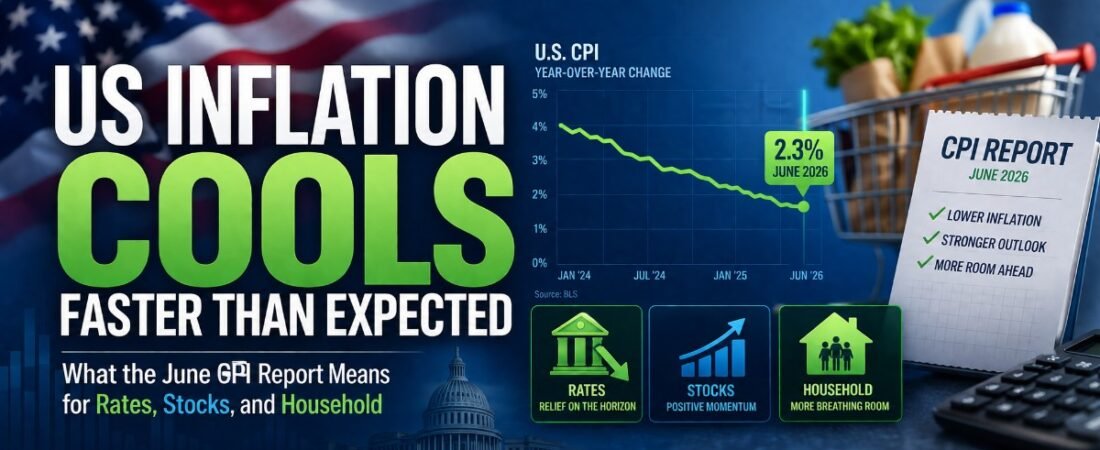
The latest US inflation June 2026 report delivered better news than markets expected. Annual consumer inflation slowed to 3.5% in June, down from 4.2% in May, while core inflation fell to 2.6% year over year and was flat on the month, suggesting that price pressures cooled more quickly than many economists had forecast.
That matters far beyond one economic release. For households in the United States, a softer CPI report may signal some relief on fuel and day-to-day costs, even if overall prices remain much higher than they were a few years ago. For investors in both the US and Europe, the report also matters because it reshapes expectations for Federal Reserve policy, bond yields, stock valuations, and the broader global inflation narrative.
What the June CPI Report Actually Said
The Bureau of Labor Statistics reported that the all-items Consumer Price Index rose 3.5% over the 12 months ending in June 2026, while the all-items-less-food-and-energy index, commonly called core CPI, rose 2.6% over the same period. On a monthly basis, headline CPI fell 0.4%, which was the biggest monthly decline since April 2020, while core CPI was unchanged from May.
The report was better than expected. Economists surveyed ahead of the release had generally expected annual CPI closer to 3.8% and core inflation closer to 2.8% to 2.9%, so the actual result landed below consensus on both headline and core measures.
Why the Report Surprised Markets
The biggest reason for the softer headline number was energy. CNBC reported that the energy index slumped 5.7% in June, its biggest monthly drop since April 2020, which gave consumers at least temporary relief and pulled the overall CPI reading lower.
At the same time, the core reading also improved, and that is usually the more important signal for central banks. Core CPI at 2.6% year over year and 0.0% month over month suggests that underlying inflation pressure cooled more than expected, even if policymakers are still unlikely to declare victory.
Why This Matters for the Federal Reserve
The immediate question after every major CPI report is simple: what does this mean for the Fed? The short answer is that the June data help the case for patience, but they do not automatically guarantee lower rates soon.
The Federal Reserve held its policy rate in June at 3.5% to 3.75%, and officials had previously raised their inflation outlook for 2026, signaling that they still saw price pressures as too high. New York Fed President John Williams said in late June that inflation remained “well above” the Fed’s 2% goal and that the current policy stance was needed to return inflation to target on a sustained basis, while also pushing his own expected return to 2% out to 2028.
A Better CPI Print Does Not End the Inflation Fight
Even after the encouraging June number, inflation is still above the Fed’s 2% target. Reuters reported that the softer CPI report would probably offer limited comfort to households and would not necessarily rule out a rate increase later in the year, especially because geopolitical tensions and energy-market risks remain unresolved.
That is the key point for readers in both America and Europe: one good inflation print changes the tone, but not the full policy regime. Central banks care about trends, not just one month, and they also care about whether lower inflation is broad-based and durable.
What Markets May Price In Next
If inflation continues to cool, markets may start to price in a lower probability of further tightening and eventually a greater chance of rate cuts. But if energy prices rebound or services inflation stays sticky, the Fed could still keep rates high for longer than households and investors want.
For bond markets, this means volatility may remain high. Investors are now balancing two competing ideas: inflation is cooling faster than expected, but the Fed still believes inflation has not yet been defeated.
What It Means for Stocks
Lower-than-expected inflation is usually positive for stocks, at least initially, because it reduces pressure on interest rates and improves the odds of a friendlier financial environment. When inflation cools, equity valuations can benefit because future corporate earnings are discounted at a lower expected rate path.
But the stock-market effect is not uniform. Some sectors benefit more than others, and a falling CPI number does not help every business in the same way.
Growth Stocks and Rate-Sensitive Sectors
Technology and other growth-oriented sectors often react positively when inflation undershoots expectations because lower rate expectations tend to support higher valuations. That is especially true when markets believe the Fed is nearing the end of its tightening cycle or at least becoming less hawkish.
Rate-sensitive areas like real estate investment trusts, homebuilders, and consumer discretionary stocks may also benefit if investors think financing costs will stop rising and perhaps eventually ease.
Defensive Sectors and Consumer Staples
Defensive sectors may not rally as sharply on softer inflation, but they can still benefit from improved stability in household budgets and consumer sentiment. If households feel less squeezed by energy and transport costs, that can modestly improve spending patterns in other parts of the economy.
Why Investors Should Stay Cautious
A single CPI report should not be treated as a full regime change. The June print was excellent relative to expectations, but inflation remains above target, energy prices are volatile, and Fed officials have recently emphasized that the broader inflation battle is not over.
For European readers and investors with US market exposure, that matters because Wall Street still drives global risk appetite. A softer US inflation trend can support global equities, but a surprise rebound in US prices or another Fed tightening step could quickly spill into European stocks, bond yields, and currency markets.
What It Means for Households in the United States
For ordinary American households, this report is encouraging but not transformative. Prices are still rising on a year-over-year basis, even if they are doing so more slowly, and many consumers continue to feel the cumulative impact of several years of elevated inflation.
That distinction matters. Lower inflation does not mean lower price levels; it means prices are rising more slowly than before. If a household’s grocery bill, rent, insurance costs, or childcare expenses climbed sharply over the last few years, a single month of better CPI data does not erase that burden.
Fuel Relief Helps Immediately
The most immediate household benefit from June’s softer inflation print is energy relief. A 5.7% monthly drop in the energy index can quickly affect gas-station prices and transport costs, which consumers notice almost instantly.
That kind of relief matters for family budgets because fuel costs ripple outward. When energy becomes cheaper, commuting is less painful, delivery costs can ease, and the psychological pressure of inflation often softens too.
Borrowing Costs Are Still a Problem
Even with a cooler CPI print, borrowing remains expensive. The Fed’s June decision kept the policy rate at 3.5% to 3.75%, and commentary around the decision suggested that high borrowing costs could persist longer than many households expected.
That means Americans carrying credit-card debt, auto loans, or variable-rate borrowing are unlikely to feel quick relief from the June CPI report alone. For many households, the practical advice is still the same: reduce expensive debt where possible, refinance opportunistically, and avoid assuming rate cuts are imminent.
Why This Matters in Europe Too
Even though the report is about the United States, the consequences extend into Europe. The US remains the world’s largest economy and a key driver of global financial conditions, so changes in US inflation expectations affect bond markets, exchange rates, and risk sentiment worldwide.
This matters even more because inflation trends are not moving in exactly the same direction everywhere. OECD headline inflation rose to 4.6% in May 2026, while Eurostat’s flash estimate pointed to a decline in euro area headline inflation in June, highlighting a fragmented inflation backdrop across advanced economies.
US Inflation vs Europe: Why the Comparison Matters
For European readers, the US June CPI report is useful as a comparison benchmark. If US inflation cools faster than expected while euro area inflation follows a different path, investors may need to think more carefully about the divergence between the Federal Reserve and the European Central Bank.
That divergence can influence:
- Bond yields in both regions.
- Equity-market leadership between US and European sectors.
- Currency moves, especially for the euro and the dollar.
- Capital flows and international portfolio allocation.
In other words, a US inflation report is not just an American story. For anyone investing across the Atlantic, it is part of a bigger global macro puzzle.
Headline CPI vs Core CPI: Which One Matters More?
A very useful educational angle for this article is the difference between headline CPI and core CPI. Headline CPI includes everything in the consumer basket, including volatile food and energy prices, while core CPI excludes food and energy to better reveal underlying inflation trends.
Both matter, but they matter in different ways. Households often feel headline inflation more directly because food and energy are unavoidable expenses, while central bankers often pay closer attention to core inflation because it can provide a cleaner signal about persistent price pressure.
Why Core Inflation Still Deserves Attention
Core CPI easing to 2.6% is an encouraging sign because it suggests the inflation slowdown was not just an energy story. But Fed officials have recently warned that underlying inflation pressures, especially in services, remain too high and may not cool smoothly every month.
That means readers should not interpret the June report as the end of inflation anxiety. A better message is this: inflation has improved meaningfully, but confirmation across several more months would be far more powerful than one favorable print.
How Investors and Households Should Read This Report
The best way to interpret the June CPI report is to separate signal from emotion. The signal is clearly positive: inflation cooled faster than expected, both headline and core inflation improved, and energy offered real short-term relief.
The emotional temptation is to jump to extremes. Some readers will want to conclude that inflation is solved and rate cuts are now inevitable, while others will dismiss the report entirely because inflation is still above target. Neither extreme is ideal.
A More Balanced Interpretation
A balanced reading of the data looks like this:
- Inflation improved materially in June.
- The decline was stronger than expected.
- Energy played a big role in the headline drop.
- Core inflation also improved, which is important.
- The Fed is still unlikely to declare victory yet.
- Households may get some relief, but high price levels and high borrowing costs remain real burdens.
That is a much more useful framework than treating the report as either a miracle or a non-event.
Final Thoughts
The June CPI report was undeniably good news. US inflation cooled faster than expected, core inflation improved, and energy prices helped deliver the biggest monthly drop in headline CPI since 2020.
But the more important lesson is not that inflation is suddenly gone. It is that the balance of risks may be shifting from relentless inflation surprises toward a more nuanced environment where central banks, investors, and households all need to judge whether this cooling trend is durable.