Reading time: around 12–15 minutes |`Published on: July 5, 2026
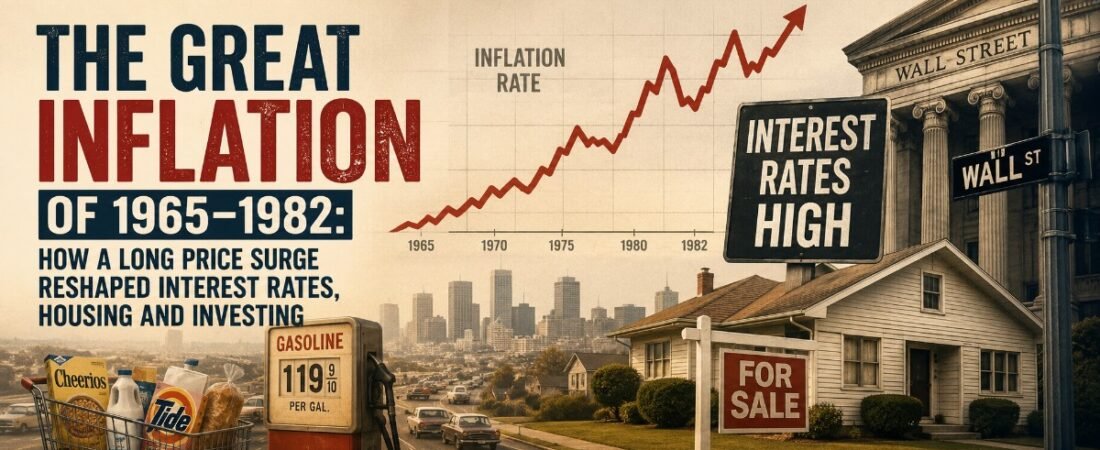
From the mid‑1960s to the early 1980s, the United States went through one of the most important inflation episodes in modern economic history: the Great Inflation.
Prices rose year after year, interest rates climbed to double‑digit levels, and the entire way people saved, borrowed, and invested was forced to change.
Understanding this period is incredibly valuable for today’s investors. It shows what can happen when inflation is not just a short spike, but a long, persistent trend that slowly erodes purchasing power and confidence.
In this guide, you will learn:
- What caused the Great Inflation
- How it changed everyday life for savers, workers, and homeowners
- What happened to major asset classes (cash, bonds, stocks, real estate)
- The policy response (especially Paul Volcker’s shock therapy)
- Key lessons for investors facing inflation risks today
What Was The Great Inflation?
Timeframe And Basic Facts
The Great Inflation is usually defined as the period from about 1965 to 1982, when inflation in the US stayed high and often unpredictable. Annual price increases moved well beyond the “low and stable” levels that households and businesses had been used to in the post‑war boom.
During this time:
- Consumer prices rose much faster than in previous decades.
- Inflation became a multi‑year phenomenon, not just a short crisis.
- People started to expect prices to rise, which itself fueled more inflation.
Instead of seeing inflation as a temporary shock, families increasingly viewed it as a normal part of life, adjusting wages, contracts, and investment choices accordingly.
Causes Of The Great Inflation
Inflation this persistent was not caused by a single event. It resulted from a combination of policy choices, global shocks, and behavioral changes.
Loose Monetary And Fiscal Policy
In the 1960s and 1970s, the US ran expansionary fiscal and monetary policies for extended periods. Governments spent heavily, and the central bank allowed money and credit to grow quickly.
Factors included:
- Spending on social programs and the Vietnam War
- A belief that higher growth and lower unemployment could be sustained with relatively little inflation
- A tendency to respond to economic slowdowns with more stimulus, even when inflation was already elevated
This mix of high demand and accommodative monetary policy laid the groundwork for persistent price increases.
Oil Shocks And Supply Disruptions
In the 1970s, major oil shocks hit the global economy. The Organization of the Petroleum Exporting Countries (OPEC) cut production and raised prices; oil became dramatically more expensive.
Because oil is embedded in transportation, industry, and heating, higher energy costs rippled across virtually all sectors, pushing up the prices of goods and services. This was a strong cost‑push component of inflation.
Wage–Price Spirals And Expectations
As prices rose, workers understandably demanded higher wages to protect their living standards. Many unions negotiated contracts with automatic cost‑of‑living adjustments, linking pay to inflation indices.
When wages rose, businesses raised prices to cover higher labor costs. This reinforced a wage–price spiral.
Crucially, expectations shifted:
- Businesses started setting prices assuming future inflation.
- Workers negotiated wages assuming future inflation.
- Savers and investors began to view inflation as persistent, not temporary.
These expectations made inflation self‑reinforcing, harder to bring down without a major policy shift.
Everyday Life During The Great Inflation
To understand inflation’s impact, it helps to look beyond macro charts and focus on households and savers.
Erosion Of Savings And Fixed Incomes
People who kept their wealth in simple bank savings accounts or under the mattress saw their purchasing power shrink fast. If inflation ran at, say, 8–10% while savings rates were much lower, real wealth was quietly destroyed.
Fixed‑income groups suffered:
- Retirees living on fixed pensions
- Savers holding long‑term fixed‑rate bonds purchased earlier
- Anyone with cash savings not indexed to inflation
Every year, their money could buy less—food, housing, healthcare, and education all felt more expensive.
Rising Prices In Daily Budgets
Households experienced inflation in very concrete ways:
- Groceries and fuel took a larger share of the monthly budget.
- Utility bills rose along with energy costs.
- Educational and medical expenses climbed, sometimes faster than wages.
Many families responded by tightening spending, postponing purchases, and looking for higher‑paying jobs or extra work to keep up.
The Housing Market And Mortgage Rates
One of the most visible channels through which the Great Inflation impacted everyday life was housing and mortgage finance.
Soaring Mortgage Interest Rates
As inflation persisted, lenders demanded higher interest rates to compensate for the loss of purchasing power. Over time, mortgage rates climbed to double‑digit levels.
This had several effects:
- Monthly payments for new buyers became much more expensive.
- Housing affordability dropped, especially for first‑time buyers.
- Refinancing older, lower‑rate loans became unattractive or impossible.
High mortgage rates acted as a brake on demand, making home purchases riskier and more stressful for many families.
House Prices And Real Returns
House prices themselves reacted in complex ways:
- In nominal terms (actual currency), property values often rose over the long run, partly reflecting general price increases.
- However, when adjusted for inflation, real house price gains could be much smaller or even negative in some periods.
Homeowners with fixed‑rate mortgages benefitted in one important way:
Their monthly payment was fixed in nominal terms, but wages and prices rose. Over time, that fixed payment became easier to bear in real terms, reducing the real burden of their debt.
This showed one of the classic inflation lessons:
Owning real assets funded by long‑term fixed debt can sometimes protect households in inflationary periods.
How Major Asset Classes Performed
The Great Inflation is a rich case study for how different asset classes behave under sustained price pressure.
Cash And Savings
Plain cash and simple savings accounts generally performed poorly. When inflation outpaced interest rates, savers experienced negative real returns.
Key takeaway:
Holding large amounts of cash for long periods in an inflationary environment is often a wealth‑destroying strategy, even if it feels safe in nominal terms.
Bonds And Fixed Income
Investors who owned long‑term, fixed‑rate bonds issued before the inflation wave suffered significant losses. As inflation and interest rates rose:
- Existing bonds with lower coupons became less attractive.
- Their market prices fell to reflect higher yields in new bonds.
- Real returns were severely reduced or negative.
This period taught investors that inflation risk is central to fixed‑income investing, especially when locking in rates for long durations.
Equities (Stocks)
Stock market performance during the Great Inflation was mixed and volatile:
- Equity valuations were pressured by higher interest rates and economic uncertainty.
- Corporate profits were affected by rising costs and changing demand.
- Over the very long term, diversified equity exposure still proved more resilient than cash or fixed‑rate bonds, but the journey was rough.
Investors and academics learned that inflation can compress valuation multiples, and that not all companies are equally capable of passing higher costs onto customers.
Real Estate And Real Assets
Real assets such as real estate displayed both challenges and protective features:
- Financing costs were high because of elevated interest rates.
- Yet the underlying property values and rents could grow with the general price level over time.
- Certain real assets (land, commodities, energy‑related businesses) offered partial hedges against inflation.
Again, the combination of tangible assets + fixed‑rate debt proved to be a powerful, if imperfect, shield against the erosion of purchasing power.
The Policy Pivot: Volcker’s Fight Against Inflation
By the late 1970s, it was clear that inflation had become deeply embedded in expectations. Bringing it down required a decisive change in policy.
Tightening Monetary Policy
Under Federal Reserve leadership that prioritized inflation control, interest rates were aggressively raised to very high levels. This tightening:
- Reduced money and credit growth.
- Signaled a strong commitment to restoring price stability.
- Made borrowing extremely expensive in the short term.
The transition was painful:
- Recessions occurred as demand slowed.
- Unemployment rose.
- Asset prices reacted sharply.
But over time, inflation was forced downward, and a new regime of lower, more stable inflation emerged.
Rebuilding Credibility And Anchoring Expectations
The key achievement of this policy pivot was not just lowering inflation temporarily, but re‑anchoring expectations:
- Businesses no longer assumed high inflation in every price decision.
- Workers and unions adjusted wage demands to a lower‑inflation world.
- Savers and investors could again plan using more predictable price dynamics.
This credibility, once rebuilt, helped maintain a more stable environment for households and markets in the decades that followed.
Lessons For Modern Investors From The Great Inflation
Why should a 21st‑century investor care about an inflation period from 1965–1982? Because the patterns and lessons are timeless.
Inflation Can Last Longer Than Expected
Short‑term spikes are one thing; multi‑year inflation waves are another. The Great Inflation shows that:
- Once inflation expectations become embedded, they are hard to reverse.
- Policy mistakes and delayed responses can prolong the pain.
- Investors must consider the possibility of persistent inflation, not just quick cycles.
Cash And Long‑Term Fixed Income Are Vulnerable
The Great Inflation reminds us that:
- Holding large amounts of cash for long periods can quietly erode wealth.
- Long‑term, fixed‑rate bonds are sensitive to inflation and interest‑rate shocks.
- Diversification across asset classes, including real assets, is critical.
Real Assets And Fixed Debt Can Be Protective
Homeowners and investors who owned property financed with fixed‑rate mortgages often fared better than cash savers:
- The real burden of debt fell over time as wages and prices rose.
- Properties could generate income and potential capital gains.
- Tangible assets often remained in demand.
For modern investors, this supports a careful but strategic use of real assets and long‑term fixed debt, within a prudent risk and leverage framework.
Policy And Credibility Matter
The Great Inflation also highlights the importance of:
- Central bank credibility in keeping inflation expectations anchored
- Clear communication about policy goals
- Balancing growth and price stability
Investors should pay attention not only to headline inflation numbers, but also to policy direction and credibility, because these shape the medium‑term environment for returns.